
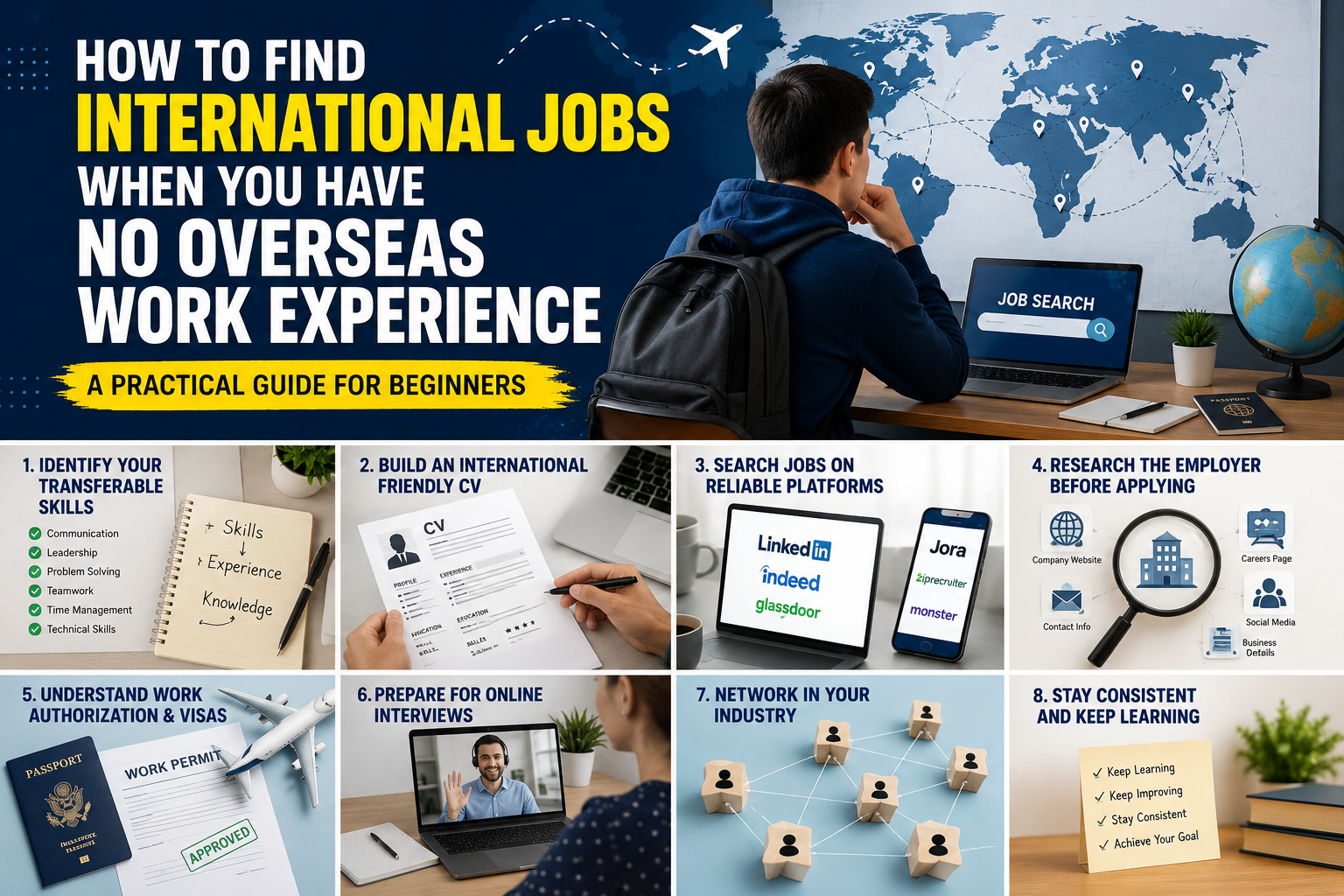
Finding a job in another country can feel difficult when you have never worked overseas before. Many international job seekers worry that employers will prefer candidates who already understand the local job market, have local work experience, or are familiar with the country’s workplace culture.
The good news is that overseas work experience is not always a requirement. Employers often care more about your skills, qualifications, reliability, communication abilities, relevant experience, and whether you meet the requirements for the position.
The challenge is knowing how to present your existing experience in a way that makes sense to an international employer.
This guide explains practical ways to search for jobs abroad, improve your CV, identify legitimate opportunities, prepare applications, and avoid common mistakes when you are applying from your home country.
Can You Get an International Job Without Overseas Experience?
Yes, it is possible.
Having no international work experience does not automatically prevent you from being hired by a foreign employer. Your previous experience can still be valuable if it is relevant to the position.
For example, someone who has worked as a software developer in Pakistan may be able to apply for software development positions in Germany, Canada, the UK, Australia, or other countries. Similarly, an experienced electrician, nurse, engineer, accountant, driver, chef, designer, or construction worker may have skills that are useful to employers internationally.
However, there may be additional requirements depending on the country and profession. Some occupations are regulated and may require professional licensing, credential recognition, language proficiency, or other approvals before you can legally work.
Therefore, the goal should not be to hide your lack of overseas experience. Instead, focus on demonstrating that your existing experience and skills can transfer to an international workplace.
Start by Identifying Your Transferable Skills
Before applying for international jobs, make a list of the skills you already have.
Transferable skills are abilities that can be useful across different companies, industries, or countries.
These can include:
- Communication
- Customer service
- Leadership
- Project management
- Problem solving
- Teamwork
- Time management
- Sales
- Digital skills
- Technical skills
- Administration
- Data analysis
- Programming
- Accounting
- Machine operation
- Healthcare skills
- Construction skills
For example, if you worked in customer service for three years, you should not simply write “Customer Service Worker” on your CV.
Think about what you actually achieved.
Perhaps you handled 50–70 customer inquiries per day, trained new employees, managed complaints, or consistently met customer satisfaction targets.
Those details give an employer a better understanding of your abilities.
Choose Countries and Jobs That Match Your Background
One of the biggest mistakes international job seekers make is applying everywhere without a clear strategy.
Instead of sending the same CV to hundreds of unrelated jobs, start with a few countries and job categories that match your qualifications.
Consider:
- Your professional experience
- Your education
- Your language abilities
- Professional licensing requirements
- Demand for your occupation
- Typical salary levels
- Work authorization requirements
- Cost of living
- Whether employers commonly hire workers from overseas
For country-specific immigration and employment requirements, always check official government websites rather than relying entirely on social media posts or recruitment advertisements.
For example, people interested in Canada can research work permits and employment information through the official Government of Canada website.
Government of Canada – Work in Canada
For the UK, employment and immigration information can be checked through the official GOV.UK website.
For Australia, applicants can review work and visa information through the official Australian Government website.
Australian Government – Working in Australia
The requirements can change, so checking official sources before making decisions is important.
Build an International-Friendly CV
Your CV is one of the most important parts of your international job search.
A common mistake is creating one generic CV and sending it to every employer.
Instead, adapt your CV to each position.
Your CV should normally make it easy for an employer to understand:
- Who you are
- What position you are looking for
- What professional experience you have
- What skills you bring
- What qualifications you hold
- What results you achieved
- What languages you speak
Focus on Achievements, Not Just Responsibilities
Compare these two examples.
Weak:
Responsible for managing social media accounts.
Stronger:
Managed social media campaigns across multiple platforms and increased monthly engagement through targeted content and audience analysis.
The second version gives the employer more information about your actual contribution.
Where possible, use numbers to explain your results.
For example:
- Managed a team of 12 employees
- Reduced processing time by 20%
- Handled more than 100 customer inquiries per week
- Increased sales by 15%
- Completed 30+ projects
- Managed a monthly advertising budget of $5,000
Only use numbers that are accurate and that you can reasonably support.
Do Not Hide Your Location
When applying for international jobs, be clear about where you currently live.
You do not need to pretend that you are already in the country.
You can state something such as:
Location: Karachi, Pakistan
Open to relocation: Yes
This gives the employer a clear understanding of your situation.
If a position requires the candidate to already have the legal right to work in the country, check that requirement carefully before applying.
Learn How Work Authorization Actually Works
A job offer and permission to work are not always the same thing.
Depending on the country and position, an international worker may need a work permit, visa, sponsorship, professional registration, or another form of authorization.
This is one of the areas where job seekers should be especially careful.
Never assume that an employer will automatically provide a visa simply because a vacancy appears online.
Read the job description carefully and research the relevant requirements through official government sources.
For European employment information, the EURES network can also be a useful starting point for learning about jobs and working conditions across European countries.
EURES – European Job Mobility Portal
Search for Jobs Through Reliable Sources
You do not necessarily need a recruitment agency to find an international job.
Many employers advertise vacancies directly through their own careers pages.
A useful approach is to create a list of companies you would genuinely like to work for and visit their official career websites regularly.
You can also use established job-search platforms.
For example, LinkedIn Jobs allows users to search for positions by location, company, industry, and other criteria.
Indeed is another widely used job-search platform with country-specific websites and international listings.
The important point is not simply where you find a vacancy. You should also verify the employer and application process before providing sensitive personal information.
Research the Employer Before Applying
When you find an attractive international job, spend a few minutes researching the company.
Look for:
- Official company website
- Company careers page
- Business address
- Professional social media profiles
- Company registration information where available
- Employee reviews
- Consistent contact information
If a job advertisement only provides a personal messaging account, promises unusually high earnings, or asks for money before employment, treat it as a warning sign.
Legitimate employers may require candidates to complete normal recruitment procedures, but you should be cautious about requests for unexplained payments.
Be Careful With International Job Scams
International job seekers are frequently targeted by fraudulent employment offers because scammers know that people are interested in relocation opportunities.
Some common warning signs include:
A Guaranteed Job or Visa
No legitimate recruiter can guarantee that an immigration authority will approve a visa simply because you paid them.
Be especially cautious about phrases such as:
“100% guaranteed visa”
or
“Guaranteed job for everyone.”
Requests for Large Upfront Payments
Be careful if someone asks you to transfer money for a job offer, interview, recruitment fee, or visa without providing clear documentation and independently verifiable information.
Unprofessional Email Addresses
An email address using a free personal account is not automatically proof of fraud, but if someone claims to represent a major company and uses an unrelated email domain, verify the person independently.
Pressure to Act Immediately
Scammers may tell you that you must pay or submit documents within a few hours to secure your position.
A genuine opportunity should allow you reasonable time to review the information.
Fake Websites
Some scammers create websites that look similar to real companies.
Do not rely only on the appearance of a website. Find the employer independently and compare contact information.
Prepare for Online Interviews
If you are applying from another country, your first interview may take place online.
Make sure you are prepared.
Before the interview:
- Test your internet connection
- Check your microphone and camera
- Choose a quiet location
- Research the company
- Review the job description
- Prepare examples from your previous work
- Dress appropriately
- Keep your CV nearby
International employers may also ask why you want to relocate.
Prepare a straightforward answer based on your career goals rather than saying that you simply want to leave your country.
For example:
“I am interested in this opportunity because the position matches my professional experience and gives me the opportunity to contribute to an international team.”
Keep your answers honest and specific.
Improve Your Language Skills
Language requirements vary significantly between countries and professions.
For some international jobs, strong English may be enough. Other positions may require knowledge of the local language.
If you are targeting a country where another language is commonly used at work, learning the basics can improve your chances and help you adapt after relocation.
Even when language skills are not formally required, communication can influence how easily you work with colleagues and customers.
Consider improving:
- Professional vocabulary
- Email writing
- Interview communication
- Workplace terminology
- Industry-specific language
Consider Remote Jobs as a Starting Point
If relocating immediately is difficult, international remote work can sometimes be another way to gain experience working with overseas companies.
For example, professionals in:
- Software development
- Graphic design
- Digital marketing
- Customer support
- Writing
- Accounting
- Virtual assistance
- Data analysis
may find opportunities to work with international clients remotely.
This does not automatically provide a pathway to immigration, but it can help you develop experience working across cultures, time zones, and international business environments.
Build a Professional Online Presence
International employers may look at your professional online presence before making a hiring decision.
Keep your LinkedIn profile updated and make sure your employment history matches the information on your CV.
Your profile should clearly communicate:
- Your profession
- Your main skills
- Your experience
- Your achievements
- Your education
- Your location
- Your career interests
If you have a portfolio, especially in creative or technical fields, include examples of your work.
A strong portfolio can sometimes demonstrate your abilities more effectively than a list of skills.
Network With People in Your Industry
Networking can be valuable when looking for international opportunities.
You can connect with professionals working in your industry and participate in relevant online communities.
However, networking should not mean repeatedly sending strangers messages asking them to “give you a job.”
Instead, build genuine professional relationships.
Ask thoughtful questions, participate in discussions, share useful information, and learn about how your industry operates in different countries.
Over time, these connections may help you discover opportunities that you would not have found through traditional job searches.
Apply Strategically Instead of Applying Everywhere
Sending hundreds of applications may feel productive, but quality often matters more than quantity.
Create a shortlist of jobs where you meet most of the important requirements.
Before applying, ask yourself:
- Do I have the required experience?
- Do I meet the education requirements?
- Do I have the necessary language skills?
- Is international hiring possible for this position?
- Does the employer mention sponsorship or work authorization?
- Can I demonstrate relevant achievements?
- Is the employer legitimate?
If the answer to most of these questions is yes, the position may be worth pursuing.
Keep Track of Your Applications
International job searches can become confusing when you apply to multiple companies.
Create a simple spreadsheet containing:
| Company | Position | Country | Application Date | Status | Follow-Up |
|---|---|---|---|---|---|
| Company A | Marketing Specialist | Germany | August 5 | Applied | August 12 |
| Company B | Customer Support | Canada | August 7 | Interview | August 10 |
| Company C | Sales Executive | UAE | August 8 | Pending | August 15 |
Tracking applications helps you avoid accidentally sending the same application multiple times and makes it easier to follow up professionally.
What If You Have Very Little Experience?
If you are a recent graduate or have limited professional experience, you can still build a stronger application.
Highlight:
- Internships
- Apprenticeships
- Freelance projects
- University projects
- Volunteer experience
- Certifications
- Personal projects
- Relevant technical skills
For example, a recent graduate applying for an entry-level marketing position could create a small portfolio showing sample social media campaigns, keyword research, content plans, or advertising projects.
The goal is to give employers evidence of what you can actually do.
Final Thoughts
Finding an international job without overseas work experience may require more preparation, but it is not an impossible goal.
Your existing experience can still have value in another country. The key is to identify transferable skills, research suitable markets, create a strong CV, apply through reliable sources, and understand the legal requirements before accepting an offer.
Do not let the absence of international experience stop you from exploring opportunities. At the same time, avoid unrealistic promises and shortcuts.
A successful international job search usually takes patience. You may need to apply for several suitable positions before receiving an interview, and some employers may prefer candidates who already have local work authorization.
Focus on opportunities that genuinely match your background, verify employers carefully, and use official government resources whenever you need information about visas or work permits.
Most importantly, remember that an international career is not built from one job application. It is built through relevant skills, professional experience, strong applications, networking, and consistent effort.
Frequently Asked Questions
Can I get an international job without working abroad before?
Yes. Many employers consider candidates based on their skills, qualifications, relevant experience, and ability to meet the requirements of the position. Overseas experience can be helpful, but it is not universally required.
How can I find international jobs from my home country?
You can search company career pages, established job platforms, professional networks, and official employment portals. Always check whether the employer is willing to consider candidates who are currently outside the country.
Do international jobs always provide visa sponsorship?
No. Some employers may sponsor eligible international workers, while others require candidates to already have the legal right to work in the country. Always check the specific job description and official immigration requirements.
Should I use a recruitment agency to find an overseas job?
A legitimate recruitment agency can be useful in some markets, but using an agency is not always necessary. Research the agency carefully, verify its credentials, understand its fees, and never assume that paying an agency guarantees employment or a visa.
How can I avoid international job scams?
Research the employer independently, verify the job through an official company website where possible, be cautious about requests for unexplained payments, and avoid offers that promise guaranteed jobs or visas.
Is remote international work the same as getting a work visa?
No. Working remotely for a foreign company does not automatically give you permission to live and work in that company’s country. Immigration and tax rules depend on your location and circumstances, so official government guidance should be checked before making relocation decisions.

Muhammad Usama is a digital content writer focused on immigration, visa, jobs, and international relocation topics.He creates clear, research-based guides to help readers better understand visa requirements, application processes, and opportunities abroad.