
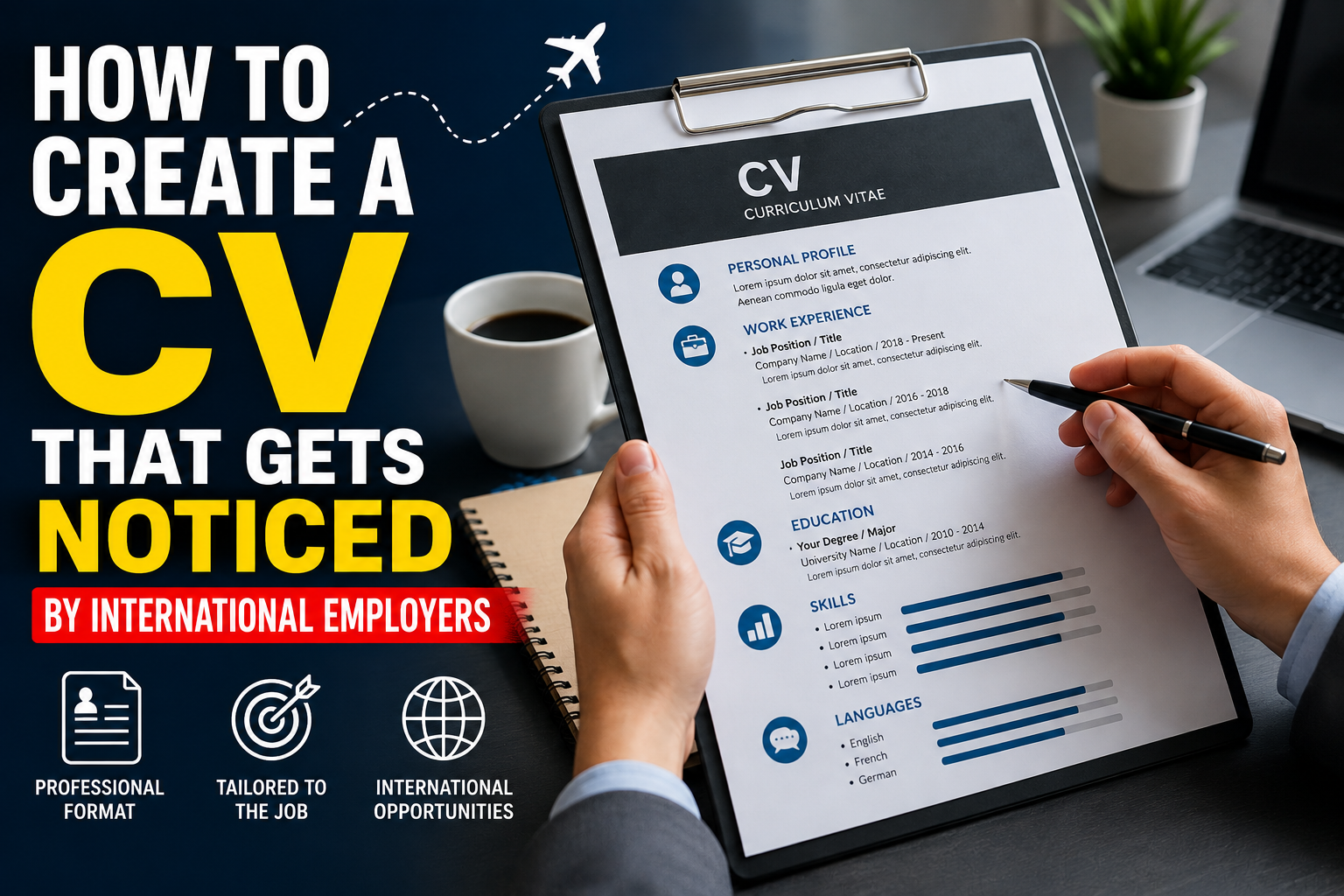
Applying for a job in another country can be exciting, but it also comes with a challenge that many international job seekers underestimate: creating a CV that an employer can understand quickly.
Your experience may be strong, but if your CV is confusing, too long, poorly organized, or not relevant to the position, an employer may never reach the most important parts of your application.
An international CV does not need to be complicated or filled with impressive-looking words. What matters most is that it clearly explains what you can do, what experience you have, and how your skills relate to the job you want.
Whether you are applying for a position in Canada, the UK, Germany, Australia, the UAE, or another country, the same basic principle applies: make it easy for the employer to understand your professional value.
This guide explains how to create a clear, professional CV for international job applications, what information to include, what mistakes to avoid, and how to adapt your CV for different employers.
What Makes an International CV Different?
There is no single CV format that works perfectly for every country.
Different employers, industries, and countries can have different expectations. Some organizations may prefer a traditional CV, while others expect a concise resume. Certain countries or professions may also have specific expectations regarding qualifications, language skills, professional registration, or other information.
For this reason, it is better to think of your CV as a professional document that should be adapted to the opportunity, rather than a document you create once and send everywhere.
A good international CV should generally be:
- Easy to read
- Relevant to the position
- Professionally formatted
- Accurate
- Concise
- Easy to scan
- Focused on skills and achievements
- Free from spelling and grammar mistakes
The UK’s National Careers Service recommends using clear formatting, headings and bullet points, keeping information concise, and tailoring your CV to the job you are applying for.
Start With the Job Description
Before writing or editing your CV, read the job advertisement carefully.
Do not start by copying everything from your old CV.
Instead, identify what the employer is actually looking for.
Look for:
- Required qualifications
- Years of experience
- Technical skills
- Soft skills
- Industry knowledge
- Language requirements
- Specific software or tools
- Responsibilities
- Certifications
- Other essential criteria
For example, imagine an employer is looking for a digital marketing specialist who understands Google Ads, SEO, analytics, and content marketing.
If your CV only says:
Digital Marketing Professional
you are not giving the employer enough information.
A stronger profile might mention your experience with paid advertising, SEO, analytics, campaign management, and content strategy—assuming those are skills you genuinely have.
The goal is not to add every possible keyword. The goal is to make the connection between your experience and the employer’s requirements obvious.
Create a Strong Professional Summary
Your professional summary is usually one of the first sections an employer sees.
It should quickly answer three questions:
- What do you do?
- What experience do you have?
- What type of role are you looking for?
Keep it relatively short.
For example:
Digital marketing professional with four years of experience in SEO, paid advertising, social media marketing, and content strategy. Experienced in managing digital campaigns, analyzing performance data, and developing online growth strategies for businesses. Seeking an international marketing role where I can contribute to measurable business growth.
This is more useful than writing a generic statement such as:
Hardworking, motivated, passionate, dedicated professional looking for a challenging opportunity.
Almost anyone can make that claim.
Your summary should tell the employer something concrete about your professional background.
Use a Professional Email Address
Your email address may seem like a small detail, but it contributes to the overall impression of your application.
Use an address that looks professional and is easy to identify.
For example:
Good:
Less professional:
If you are applying internationally, avoid using an email address that may make your application look informal.
You should also make sure your phone number is written clearly, including the appropriate international country code when relevant.
Include Your Location Clearly
If you are applying from another country, do not try to hide your current location.
Instead, make it clear.
For example:
Location: Lahore, Pakistan
Open to relocation: Yes
This gives the employer useful context.
If the job requires candidates to already have permission to work in the country, check the requirement before applying.
Do not claim that you have work authorization if you do not.
Immigration and work-permit rules are separate from CV writing, so always verify those requirements through official government sources.
Should You Include Your Nationality or Date of Birth?
There is no universal answer because CV conventions vary between countries.
For example, the UK’s National Careers Service advises applicants not to include age, date of birth, marital status, or nationality on a standard CV.
That does not mean every country follows exactly the same convention.
Before applying, research the normal CV expectations for the country and employer.
The safest approach is usually to include information that is relevant to your professional qualifications and the application, unless the employer or local convention specifically requires something else.
Highlight Achievements Instead of Only Listing Duties
One of the biggest CV mistakes is turning every previous job into a list of responsibilities.
For example:
Managed social media accounts.
Created content.
Worked with customers.
Prepared reports.
These statements tell an employer what your job involved, but they do not show how well you performed.
Whenever possible, turn responsibilities into achievement-focused statements.
Instead of:
Managed social media accounts.
Consider:
Managed social media content across multiple platforms and improved audience engagement through targeted content planning.
Instead of:
Responsible for sales.
Consider:
Managed customer sales activities and consistently followed up with prospects to support monthly revenue targets.
Only include results that are accurate.
Never invent percentages, revenue figures, client numbers, or achievements simply because they look impressive.
Use Numbers When They Add Meaning
Numbers can make professional achievements easier to understand.
For example:
- Managed a team of 10 employees
- Completed 40+ client projects
- Handled approximately 80 customer inquiries per week
- Reduced processing time by 15%
- Managed a monthly advertising budget of $3,000
- Increased website traffic by 25%
Specific information can make your experience more concrete.
However, numbers should never be added just for decoration.
If you do not know the exact figure, use a truthful description rather than guessing.
Organize Your Work Experience Properly
For most applicants, work experience should be listed in reverse chronological order, starting with the most recent position.
A simple structure is:
Job Title
Company Name — City, Country
Month Year – Month Year
- Achievement or responsibility
- Achievement or responsibility
- Achievement or responsibility
- Relevant skill or result
For example:
Digital Marketing Specialist
ABC Marketing — Karachi, Pakistan
January 2023 – Present
- Developed SEO and content strategies for business websites.
- Managed paid advertising campaigns across major digital platforms.
- Analyzed campaign performance and prepared monthly reports.
- Collaborated with content and design teams to improve marketing campaigns.
Keep the information relevant to the job you are applying for.
You do not need to describe every minor task you have ever performed.
Do Not Make Your CV Too Long
More information does not automatically make a CV better.
An employer should be able to find your most important qualifications without reading several pages of unnecessary detail.
For example, Canada’s official Job Bank recommends keeping a resume clear and concise and emphasizes highlighting relevant accomplishments rather than simply listing responsibilities.
The appropriate length can depend on your experience and profession.
A recent graduate may have a relatively short CV, while a senior professional with many years of experience may reasonably need more space.
The important question is:
Does every section help the employer understand why I am suitable for this particular position?
If not, consider removing or shortening it.
Make Your Skills Section Specific
Avoid filling your skills section with vague terms such as:
- Hardworking
- Honest
- Friendly
- Motivated
- Smart
- Fast learner
These qualities may be positive, but they are difficult to verify from a list.
Instead, include specific skills relevant to the job.
For example:
Digital Marketing Skills
- Search engine optimization
- Google Ads
- Social media advertising
- Content strategy
- Keyword research
- Google Analytics
- Email marketing
Technical Skills
- Python
- JavaScript
- SQL
- WordPress
- Git
- Microsoft Excel
Your skills should always reflect your actual abilities.
Include Language Skills
Language ability can be particularly important when applying internationally.
Create a separate language section if your language skills are relevant to the position.
For example:
Languages
- English — Professional working proficiency
- German — Intermediate
- Urdu — Native
Be honest about your level.
Do not describe yourself as fluent if you can only communicate at a basic level.
Some employers may test language ability during an interview, so accurate information is important.
Add Relevant Certifications
Professional certifications can strengthen your CV when they are relevant to the job.
Examples could include:
- Industry certifications
- Software certifications
- Professional licenses
- Safety training
- Language certifications
- Technical qualifications
- Digital marketing certifications
Do not add every online course you have ever completed.
Choose qualifications that demonstrate knowledge or skills related to the position.
If a profession is regulated, such as certain healthcare, engineering, legal, or technical occupations, research whether additional recognition or licensing is required in the destination country.
A CV cannot replace a professional license when the law requires one.
Include Education in a Clear Format
Your education section should be easy to understand.
A simple structure is:
Bachelor of Business Administration
University Name — Country
2019–2023
You can include relevant coursework, academic achievements, projects, or certifications when they strengthen your application.
If you are an experienced professional, your work history may deserve more attention than older academic information.
If you are a recent graduate, education, projects, internships, and relevant training may deserve more space.
Explain Employment Gaps Honestly
Having a gap in your employment history does not automatically mean your CV will be rejected.
People leave work for many legitimate reasons, including education, family responsibilities, career changes, relocation, or personal circumstances.
The UK’s National Careers Service advises applicants to be open and honest about employment gaps and to focus on useful skills or experiences gained during that period.
If you completed training, freelanced, volunteered, studied, traveled for a legitimate reason, or worked on personal projects during the gap, include relevant information where appropriate.
Do not create fake employment to make your CV look continuous.
Honesty is more valuable than an artificially perfect work history.
Choose a Simple CV Design
A professional CV does not need complicated graphics.
For most international applications, readability should come before visual decoration.
Use:
- Clear section headings
- Consistent fonts
- Consistent spacing
- Bullet points
- Simple formatting
- Good contrast
- Enough white space
Avoid excessive:
- Colors
- Icons
- Decorative graphics
- Unusual fonts
- Large photographs
- Complex tables
- Long paragraphs
A simple design also makes it easier for employers to scan the document.
If you are applying for a creative role, such as graphic design, UI/UX, photography, or advertising, you can show more creativity—but your CV should still remain easy to understand.
Think About Applicant Tracking Systems
Some companies use applicant tracking systems, often called ATS, to help organize applications.
There is no universal formula that guarantees a CV will pass every ATS.
However, using clear headings and standard terminology can make your document easier for both software and humans to understand.
For example, use familiar headings such as:
- Professional Summary
- Work Experience
- Education
- Skills
- Certifications
- Languages
When a job advertisement specifically asks for a skill you genuinely possess, use the same terminology naturally in your CV.
For example, if the employer says “project management,” do not replace it with an unusual phrase such as “project coordination expertise” if project management is the actual skill they are requesting.
Do not fill your CV with hidden keywords or repeat the same phrase dozens of times.
Your document should remain natural and readable.
Tailor Your CV for Every Important Application
One of the strongest improvements you can make is to stop treating your CV as a one-size-fits-all document.
Suppose you are applying for two positions:
Position A: Digital Marketing Specialist
Position B: Sales Manager
Your experience may overlap, but the most relevant information will be different.
For the marketing role, you might emphasize:
- SEO
- Paid advertising
- Content strategy
- Analytics
- Social media
For the sales position, you might emphasize:
- Client relationships
- Lead generation
- Negotiation
- Revenue growth
- Team leadership
The UK’s National Careers Service and Canada’s Job Bank both recommend tailoring a CV or resume to the specific job rather than relying on a generic document.
Consider Using Europass for European Applications
If you are applying for opportunities in Europe, Europass can be a useful official resource.
Europass provides an online CV builder and allows users to create, store, and share CVs in multiple languages. It also recommends tailoring your CV to the vacancy and keeping the information clear and relevant.
However, you should still read the employer’s instructions.
If a company requests a particular format, follow the employer’s instructions rather than automatically submitting a Europass CV.
Use Reliable Career Resources
If you are preparing a CV for international applications, official career resources can provide useful guidance.
For example, Canada’s Job Bank provides resume resources and a resume builder for job seekers.
Canada Job Bank – Resume Resources
The UK’s National Careers Service also provides guidance about CV sections, applications, interviews, and career planning.
UK National Careers Service – CV Advice
These resources are useful because employment practices can vary between countries.
What You Should Usually Avoid on an International CV
Before submitting your CV, review it for information that may be unnecessary or inappropriate for the specific market.
Avoid:
- False qualifications
- Fake employment history
- Exaggerated achievements
- Unnecessary personal information
- Irrelevant jobs taking up most of the document
- Spelling mistakes
- Unprofessional email addresses
- Excessive design elements
- Large blocks of text
- Generic statements with no evidence
- Salary expectations unless requested
- References unless requested
- Unverified claims about work authorization
Some countries and industries have different conventions, so research local expectations before removing or adding personal information.
Create a Master CV
A useful strategy for international job seekers is to maintain two versions of their CV:
1. Master CV
This contains your complete professional history, including:
- All relevant jobs
- Projects
- Certifications
- Skills
- Education
- Achievements
- Volunteer experience
- Languages
2. Tailored CV
This is the shorter version you actually send to an employer.
You select the most relevant information from your master CV and adapt it to the particular position.
This saves time while still allowing you to personalize applications.
Ask Someone to Proofread Your CV
A small spelling mistake can make a professional document look careless.
Before sending your CV:
- Check spelling.
- Check grammar.
- Verify phone and email details.
- Check employment dates.
- Check company names.
- Check qualification names.
- Make sure formatting is consistent.
- Read the document from the employer’s perspective.
It can also help to ask another person to read it.
The UK’s National Careers Service specifically recommends having someone else check your CV for spelling and grammar.
Final CV Checklist
Before clicking the application button, ask yourself:
Contact information
- Is my name clearly visible?
- Is my email professional?
- Is my phone number correct?
- Is my location accurate?
Professional summary
- Does it explain what I do?
- Is it relevant to the job?
- Does it avoid generic statements?
Experience
- Are my most relevant roles easy to find?
- Have I included achievements?
- Are my dates accurate?
- Have I avoided exaggerating results?
Skills
- Are the skills relevant?
- Do they match my actual abilities?
- Have I included important technical skills?
Education
- Are my qualifications clearly listed?
- Are important certifications included?
International application
- Have I checked the country’s CV conventions?
- Have I checked work authorization requirements?
- Have I been honest about my current location?
Final review
- Is the CV easy to read?
- Is it tailored to the position?
- Are there spelling or grammar mistakes?
- Does every section add value?
Final Thoughts
A CV that gets noticed by international employers is not necessarily the most colorful, longest, or most complicated CV.
It is the one that communicates the right information clearly.
Your first goal is to make the employer understand your professional background. Your second goal is to demonstrate that your experience matches the position. Your third goal is to make the document easy to read and easy to trust.
If you are applying from another country, be transparent about your location and work authorization. Do not exaggerate qualifications or create achievements that you cannot support.
Take time to research the employer, understand the job description, and adapt your CV for the position.
A strong CV cannot guarantee an interview or a job offer, because hiring decisions depend on many factors. But a clear, accurate, relevant, and well-tailored CV gives an employer a much better reason to consider your application.
For international job seekers, that is the real objective: make your experience easy to understand, show the value you can bring, and give employers a clear picture of why you are a good match for the role.
Frequently Asked Questions
How long should an international CV be?
There is no single length that works for every profession or country. Keep it as concise as possible while providing the information needed to demonstrate your qualifications. Experienced professionals may need more space than recent graduates.
Should I use the same CV for every country?
Not necessarily. CV conventions can vary by country, industry, and employer. Research the expectations of your target market and follow the employer’s application instructions.
Should I include a photo on my CV?
Photo requirements vary by country and employer. Do not assume that a photograph is always necessary. Check the conventions of the country and the specific application before including one.
Should I mention that I need visa sponsorship?
If the application asks about work authorization or sponsorship, answer honestly. Never claim that you have permission to work in a country if you do not have it.
Can a fresh graduate create a strong international CV?
Yes. A graduate can highlight education, internships, academic projects, certifications, volunteer work, relevant skills, and practical projects. The important thing is to demonstrate useful abilities rather than focusing only on the lack of full-time experience.
Is Europass CV good for international jobs?
Europass is an official European CV tool and can be useful for applications in Europe. However, not every employer requires or prefers the same format. Always follow the employer’s instructions and adapt your CV to the vacancy.
Should I include references on my CV?
Reference requirements vary. Some employers may request them later in the hiring process. If references are not requested, you generally do not need to use valuable CV space for full reference details.
Can a good CV guarantee an international job?
No. A CV can improve how clearly you present your qualifications, but it cannot guarantee an interview, job offer, sponsorship, or visa approval. Hiring decisions depend on the employer, candidate pool, qualifications, work authorization, and other factors.

Muhammad Usama is a digital content writer focused on immigration, visa, jobs, and international relocation topics.He creates clear, research-based guides to help readers better understand visa requirements, application processes, and opportunities abroad.