
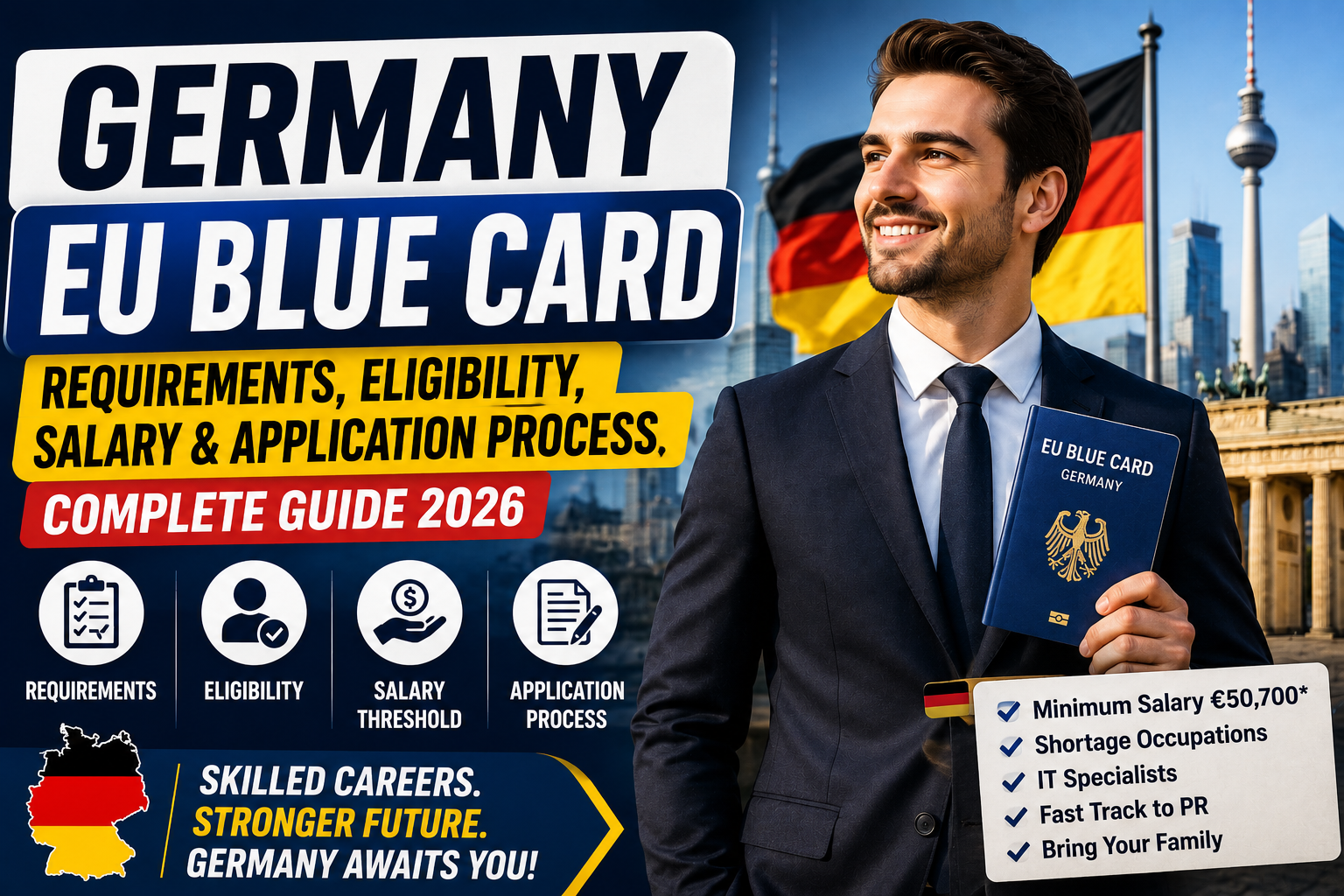
Germany has become an attractive destination for qualified professionals looking to build an international career. Its strong industrial base, technology sector, healthcare system and demand for skilled workers have created opportunities for professionals from many countries.
For highly qualified non-EU professionals, one of the most important immigration options is the Germany EU Blue Card.
The EU Blue Card is designed for highly qualified workers who have a qualifying academic background and a suitable employment offer in Germany. Unlike a general job-seeker arrangement, the Blue Card is connected to a specific qualified employment opportunity and salary requirements.
The process can look complicated when you first encounter terms such as qualification recognition, shortage occupations, salary thresholds and residence permits. However, once the process is broken down into individual stages, it becomes much easier to understand.
This guide explains the Germany EU Blue Card requirements, salary thresholds, eligible applicants, documents, application process, job search strategies, family options and possible long-term residence pathways.
Important: Immigration rules and salary thresholds can change. The figures in this article refer to the 2026 requirements available from official German sources. Applicants should always check the latest government information before submitting an application.
What Is the Germany EU Blue Card?
The EU Blue Card is a residence title designed for highly qualified professionals from outside the European Union.
Germany’s official “Make it in Germany” portal describes the EU Blue Card as one of the main residence options for highly skilled workers.
The basic idea is relatively straightforward: a qualified professional receives a suitable job offer in Germany, meets the educational or professional requirements, satisfies the applicable salary threshold and then applies for the appropriate residence authorization.
The Blue Card is therefore not simply a general permit allowing someone to enter Germany and search for any job.
A genuine employment opportunity is an important part of the standard application.
Who Can Apply for a Germany EU Blue Card?
The Blue Card is mainly aimed at highly qualified professionals who have a recognized or comparable academic qualification and a suitable employment contract.
Depending on the situation, there are also special provisions for certain IT professionals and recent graduates.
A typical applicant might be:
- A software engineer
- A data specialist
- An engineer
- A doctor
- An architect
- A scientist
- A technology professional
- A mathematics or STEM graduate
- A qualified manager in an eligible occupation
- Another professional whose position meets the relevant Blue Card requirements
The occupation itself matters. Having a university degree does not automatically mean that every job will qualify.
Germany EU Blue Card Requirements in 2026
The main requirements can be summarized as follows:
| Requirement | General rule |
|---|---|
| Qualification | Recognized/comparable academic qualification or qualifying alternative |
| Job offer | Specific job in Germany |
| Employment duration | Generally at least 6 months |
| Salary | €50,700 gross/year for standard occupations in 2026 |
| Lower salary threshold | €45,934.20 gross/year for eligible shortage occupations and certain recent graduates |
| Regulated professions | Required professional licence/permission |
| Employer | Genuine German employment opportunity |
| Applicant | Generally a third-country national |
Germany’s official information confirms that the job offer normally needs to have a minimum employment period of six months and must match the applicant’s qualification. For 2026, the standard gross annual salary threshold is €50,700. A lower threshold of €45,934.20 applies in eligible shortage occupations, and the same lower threshold can apply to certain people entering the labour market shortly after obtaining their degree.
EU Blue Card Salary Requirement
Salary is one of the most important parts of the Germany EU Blue Card application.
For 2026, the standard minimum gross annual salary is:
€50,700
However, a lower threshold of:
€45,934.20
can apply to eligible shortage occupations.
The lower threshold can also apply to certain recent graduates whose final academic qualification was obtained less than three years ago.
The distinction is important because an applicant should not assume that every professional must earn €50,700 or that every applicant can use the lower threshold.
The exact occupation and personal circumstances need to be considered.
What Are Germany’s EU Blue Card Shortage Occupations?
Germany provides special salary treatment for certain shortage occupations.
The official list includes several groups such as:
- Academic STEM professionals
- Certain ICT professionals and managers
- Doctors
- Dentists
- Pharmacists
- Veterinarians
- Certain nursing and midwifery professionals
- Teachers and educators
- Certain managers in manufacturing, construction, logistics and related services
- Certain architecture and planning professionals
The list is broader than simply “IT jobs.”
This is useful for professionals who have the right qualifications but may not reach the standard Blue Card salary threshold.
Because shortage-occupation classifications and salary figures can change, applicants should check the official list when applying rather than relying on an old blog post.
EU Blue Card for Recent Graduates
Germany also provides a useful option for people entering the labour market.
If the applicant obtained their latest academic or comparable qualification less than three years ago, a lower salary threshold of €45,934.20 can apply in 2026.
This provision is particularly relevant to recent graduates who may not yet have many years of professional experience.
However, the person still needs a suitable job offer and must satisfy the other requirements.
Therefore, a fresh graduate should not interpret the rule as meaning that any entry-level job automatically qualifies.
The position and employment conditions still need to meet the applicable rules.
Can an IT Professional Get an EU Blue Card Without a University Degree?
Germany has a special route for certain experienced IT professionals.
According to the official German government portal, an IT specialist without a formal academic qualification may qualify for an EU Blue Card if they meet the relevant professional-experience requirement and salary threshold.
For 2026, the applicable salary threshold in this special case is €45,934.20 gross per year, and the applicant generally needs at least three years of IT experience at an academic level within the previous seven years. The job must also require that level of experience.
This is an important development for experienced technology professionals who built their careers through practical experience rather than a traditional university route.
Still, applicants should document their experience carefully.
Does the Job Have to Match Your Degree?
For the normal EU Blue Card route, the employment needs to be appropriate to the applicant’s qualification.
Germany’s official guidance states that the job must match the applicant’s academic qualification.
This is different from the broader skilled-worker residence route, where Germany has more flexibility concerning the relationship between qualification and employment.
Therefore, someone with a business degree should not assume that every technology or engineering position will automatically qualify for a Blue Card.
The actual circumstances matter.
Recognition of Foreign Qualifications
Qualification recognition is an important topic for international professionals.
If you earned your degree outside Germany, you may need to demonstrate that the qualification is recognized or comparable.
The process can differ depending on the profession.
Regulated professions can have additional requirements because a professional licence may be necessary before the person can legally work.
Examples of regulated professions can include certain healthcare occupations.
Applicants should determine the recognition situation before making major plans.
Regulated vs Non-Regulated Professions
A useful distinction is between regulated and non-regulated professions.
Regulated profession
A licence or official authorization may be required to practise the profession.
Examples can include certain medical and healthcare professions.
Non-regulated profession
The qualification-recognition process may work differently, and a professional may not need the same type of licence.
Because the requirements vary, applicants should check their specific occupation rather than applying a general rule to every profession.
How to Find a Blue Card Job in Germany
For many applicants, finding the right job is actually the hardest part of the process.
Start with reputable sources.
LinkedIn Jobs
LinkedIn has a large Germany jobs section covering technology, engineering, marketing, finance, healthcare and many other sectors.
You can search by:
- Job title
- City
- Industry
- Remote/hybrid options
- Experience level
It is also useful to search for employers that regularly hire international professionals.
German Government Job Resources
Germany’s official “Make it in Germany” portal provides job-search information for international professionals.
Employer Career Pages
Large companies often advertise vacancies directly on their own websites.
This can be preferable to relying entirely on unknown recruiters.
How to Make Your CV More Suitable for Germany
A strong application can make a major difference.
Your CV should clearly show:
- Education
- Professional experience
- Technical skills
- Languages
- Certifications
- Major achievements
- Current location
- Contact details
- LinkedIn profile if relevant
Avoid filling the CV with vague statements.
Instead of writing:
“Responsible for software development.”
A stronger description could be:
“Developed and maintained web applications using modern JavaScript frameworks and improved application performance through code optimization.”
The goal is to help a German employer quickly understand what you can actually do.
Germany EU Blue Card Application Process
The process can vary according to nationality and personal circumstances, but a typical route looks like this:
Step 1: Check Eligibility
Review your qualification, occupation, salary and job offer.
Step 2: Find a Suitable Job
Secure an employment contract or binding job offer that meets the Blue Card conditions.
Step 3: Check Qualification Recognition
Determine whether your academic qualification is recognized or comparable.
Step 4: Prepare Documents
Collect your passport, qualification documents, employment contract and other required evidence.
Step 5: Apply for the Visa
If you require an entry visa, apply through the appropriate German mission or the online Consular Services Portal where available.
Germany’s Federal Foreign Office launched the Consular Services Portal as a central online route for various visa applications, including employment-related visas.
Step 6: Attend the Required Appointment
Depending on the application route, you may need to provide biometric information and original documents.
Step 7: Enter Germany
After receiving the appropriate visa, you can travel to Germany according to the conditions of your authorization.
Step 8: Receive the Residence Title
After arrival, the appropriate authority handles the residence permit/Blue Card process according to the applicable procedure.
Documents Commonly Required
The exact checklist depends on your country and individual circumstances, but applicants should be prepared to provide documents such as:
- Valid passport
- Employment contract or binding job offer
- University degree
- Qualification evidence
- Recognition/comparability evidence where applicable
- Professional licence for regulated professions
- Proof of accommodation where requested
- Health insurance evidence
- Visa application forms
- Passport photographs where required
- Other documents requested by the German mission
Never assume that a checklist from another country will be identical to yours.
Always check the German embassy or consulate responsible for your application.
How Long Is the EU Blue Card Valid?
The residence authorization is generally connected to the employment period and applicable rules.
The exact validity can depend on the employment contract and immigration circumstances.
Applicants should not confuse the validity of the entry visa with the duration of the residence title.
Once living in Germany, the residence authority manages the relevant residence documentation.
Can EU Blue Card Holders Change Jobs?
The Blue Card provides certain employment mobility rights, but job changes should not be handled casually.
If you want to change employers, check the current rules and whether notification or approval is required.
This is especially important shortly after receiving the Blue Card.
Never assume that you can simply stop working for one employer and immediately start another without checking your residence conditions.
Can Family Members Join a Blue Card Holder?
One advantage of Germany’s skilled immigration system is the possibility of family reunification for eligible family members.
Spouses and children may be able to join the Blue Card holder under applicable rules.
The exact documentation and conditions depend on the family relationship and individual situation.
Before travelling, families should confirm the requirements with the relevant German authorities.
Can the EU Blue Card Lead to Permanent Residence?
The EU Blue Card can provide a pathway toward longer-term residence in Germany.
Depending on the circumstances, Blue Card holders can become eligible for a settlement permit after meeting the relevant residence period and other requirements.
Language knowledge can affect the timeline.
Applicants should check the current settlement-permit rules rather than assuming that holding a Blue Card automatically results in permanent residence.
EU Blue Card vs Skilled Worker Visa
These two routes are often confused.
| Feature | EU Blue Card | Skilled Worker Residence |
|---|---|---|
| Main target | Highly qualified professionals | Qualified workers |
| Academic qualification | Usually important | Academic or vocational qualification |
| Salary threshold | Specific annual threshold | Different rules |
| Job offer | Required | Required |
| Qualification-job relationship | Important for Blue Card | More flexible |
| Regulated professions | Licence may be required | Licence may be required |
| Long-term options | Yes, subject to requirements | Yes, subject to requirements |
Germany’s skilled-worker route can therefore be a better option for some applicants who do not meet the Blue Card salary or qualification conditions.
Common EU Blue Card Mistakes
Mistake 1: Looking Only at the Salary
A high salary does not automatically make a job eligible.
Mistake 2: Ignoring Qualification Requirements
The job and qualification relationship matters.
Mistake 3: Using an Outdated Salary Figure
Salary thresholds can change annually.
Mistake 4: Trusting “Guaranteed Visa” Recruiters
No private recruiter can guarantee a government decision.
Mistake 5: Sending Fake Documents
False education or employment evidence can create serious immigration problems.
How to Avoid Germany Visa Scams
Be cautious if someone claims:
- “Guaranteed EU Blue Card”
- “Guaranteed Germany job”
- “No documents required”
- “Pay us and your visa is approved”
- “Embassy approval is guaranteed”
A legitimate employer should be identifiable and should provide a genuine job description.
Verify company details independently.
Do not transfer large amounts of money to an unknown person simply because they claim to have a German employer connection.
Is the Germany EU Blue Card Worth Considering?
For a qualified professional who has a suitable German job offer and meets the salary and qualification requirements, the EU Blue Card can be an attractive immigration option.
It is particularly relevant to professionals in technology, engineering, healthcare, science and other specialized fields.
However, the right route depends on the applicant’s individual profile.
Someone who does not qualify for the Blue Card may still have options through Germany’s skilled-worker residence routes or other immigration pathways.
Final Checklist
Before applying, review:
- Do I have a genuine German job offer?
- Does the job meet the required salary?
- Is my qualification recognized or comparable?
- Is my profession regulated?
- Do I need professional licensing?
- Are my documents consistent?
- Have I checked the latest German government rules?
- Am I applying through a legitimate visa channel?
- Have I checked the employer carefully?
Final Thoughts
The Germany EU Blue Card can be a valuable route for highly qualified professionals who want to work and build a future in Germany.
But it should not be viewed as a shortcut where simply having a university degree guarantees approval.
A successful application depends on several pieces fitting together: qualification, job offer, salary, occupation, documentation and immigration requirements.
If you are preparing from outside Germany, spend time researching employers and improving your professional application before worrying only about the visa form.
A strong job offer from a legitimate German employer is the foundation of the process.
For the most accurate information, applicants should verify current requirements through Germany’s official immigration and visa resources before applying.

Muhammad Usama is a digital content writer focused on immigration, visa, jobs, and international relocation topics.He creates clear, research-based guides to help readers better understand visa requirements, application processes, and opportunities abroad.