
For skilled workers and professionals who want to build a long-term future in the United States, employment-based immigration can be an important pathway to explore.
One of the major employment-based immigrant categories is the EB-3 visa.
Unlike temporary work classifications such as H-1B or H-2B, EB-3 belongs to the employment-based immigrant system and can lead to lawful permanent residence when all requirements are met.
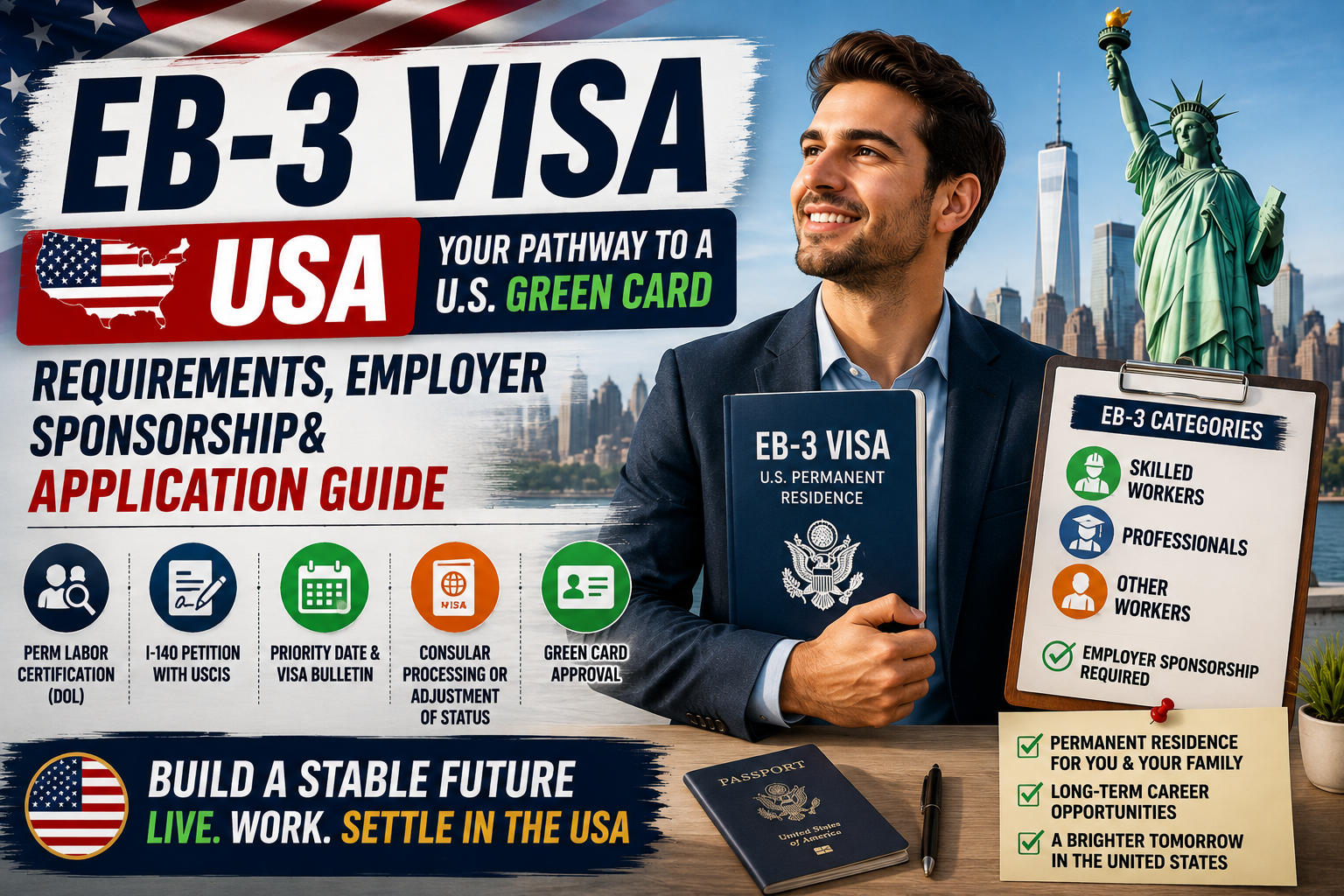
The category covers three broad groups:
- Skilled workers
- Professionals
- Other workers
However, EB-3 should not be described as an easy “work visa” or a guaranteed green-card program.
The process can involve a U.S. employer, Department of Labor labor certification, USCIS petition processing and, for applicants outside the United States, immigrant visa processing through the Department of State.
There can also be waiting periods because employment-based immigrant visas are subject to numerical limits and priority-date rules.
This guide explains the EB-3 category, eligibility, employer sponsorship, PERM labor certification, Form I-140, priority dates, visa availability, consular processing, adjustment of status, costs and common scams.
Important: Immigration laws, fees, processing times and Visa Bulletin dates can change. This article provides general educational information and should not replace advice from a qualified immigration professional.
What Is the EB-3 Visa?
EB-3 is the Employment-Based Third Preference immigrant category.
It is intended for certain foreign workers who qualify as:
- Skilled workers
- Professionals
- Other workers
The U.S. Department of State identifies EB-3 as the employment-based third preference category for skilled workers, professionals and other workers.
A successful EB-3 case can lead to lawful permanent residence, commonly referred to as a Green Card.
The important distinction is that EB-3 is an immigrant pathway, while H-1B and H-2B are generally temporary nonimmigrant classifications.
The Three EB-3 Subcategories
1. EB-3 Skilled Workers
The skilled-worker category generally covers positions requiring at least two years of training or experience.
The worker must meet the job’s stated requirements.
For example, an employer may have a permanent position requiring several years of specialized work experience.
The applicant would need to demonstrate that they meet the required experience or training standard.
2. EB-3 Professionals
The professional category generally covers positions requiring a U.S. bachelor’s degree or foreign equivalent.
The degree requirement needs to be part of the qualifying job opportunity.
Simply possessing a bachelor’s degree does not mean that someone automatically qualifies for EB-3.
The permanent job itself must meet the relevant requirements.
3. EB-3 Other Workers
The Other Workers subcategory covers certain permanent positions requiring less than two years of training or experience.
It is sometimes called the “unskilled worker” category in general discussions, but the formal immigration terminology is Other Workers.
This category has its own numerical limitation within EB-3, which can affect visa availability and waiting times.
Does EB-3 Require Employer Sponsorship?
For the normal employer-sponsored EB-3 process, yes.
A U.S. employer generally sponsors the foreign worker for a permanent job opportunity.
This is fundamentally different from a visa where the applicant simply applies independently.
The employer needs to be prepared to complete the required immigration steps and demonstrate that the permanent job opportunity is genuine.
The U.S. Department of Labor explains that the PERM labor-certification application is the employer’s responsibility and that, after approval, the employer can seek immigration authorization through USCIS.
What Is PERM Labor Certification?
PERM stands for the Program Electronic Review Management labor-certification process.
It is administered by the U.S. Department of Labor.
The purpose of the labor-certification process is to protect U.S. workers and ensure that hiring the foreign worker does not adversely affect the wages and working conditions of similarly employed U.S. workers.
The employer generally needs to show that it has a permanent, full-time job opportunity and that it has followed the required recruitment and labor-certification procedures.
EB-3 PERM Process
The exact process can vary, but the employer generally goes through several stages.
Step 1: Define the Permanent Job
The employer identifies a permanent, full-time position.
The job description should accurately explain:
- Job duties
- Minimum education
- Required experience
- Work location
- Wage
- Other minimum requirements
The employer should not create requirements specifically designed to exclude qualified U.S. workers.
Step 2: Obtain a Prevailing Wage Determination
The employer generally needs a prevailing wage determination before filing the PERM application.
The Department of Labor states that employers must have a prevailing wage determination for the job opportunity issued by the National Prevailing Wage Center before filing a PERM application.
The prevailing wage is intended to establish a wage floor for the relevant occupation and location.
Step 3: Recruitment
The employer conducts the required recruitment steps.
The purpose is to test the U.S. labor market and determine whether qualified U.S. workers are available for the position.
The exact advertising and recruitment requirements depend on the type of occupation and applicable PERM rules.
Step 4: File PERM Application
If the employer completes the required recruitment and remains eligible to sponsor the position, it can file the labor-certification application with the Department of Labor.
Step 5: DOL Decision
The Department of Labor reviews the application.
The case can be certified, denied or audited depending on the circumstances.
Step 6: File Form I-140
After labor certification is approved, the employer generally files an Immigrant Petition for Alien Workers (Form I-140) with USCIS for the qualifying EB-3 worker.
USCIS identifies Form I-140 as the petition used for employment-based categories including skilled workers, professionals and other workers.
What Is the Prevailing Wage?
The prevailing wage is an important protection in employment-based immigration.
The Department of Labor explains that prevailing wage rules are intended to prevent foreign-worker hiring from adversely affecting wages and working conditions for similarly employed U.S. workers.
The wage depends on factors such as:
- Occupation
- Geographic area
- Job requirements
- Applicable wage data
The employer generally needs to offer the required wage for the permanent position.
EB-3 Eligibility Requirements
Requirements depend on which EB-3 subcategory applies.
Skilled Worker Requirements
A skilled worker position generally requires at least two years of training or experience.
The applicant must be able to demonstrate that they meet the employer’s legitimate minimum requirements.
Professional Requirements
A professional position generally requires a bachelor’s degree or foreign equivalent.
The applicant needs to possess the required qualification.
Other Worker Requirements
Other Worker positions generally require less than two years of training or experience.
The job itself must qualify for the relevant category.
Does Every Job Qualify for EB-3?
No.
EB-3 is not a general immigration program for every occupation.
The position must satisfy the applicable requirements.
It also needs to be a qualifying permanent, full-time employment opportunity under the relevant labor-certification rules unless an applicable exception applies.
This is why applicants should not simply search for “EB-3 visa” without examining the actual job.
What Is a Priority Date?
The priority date is one of the most important concepts in employment-based immigration.
It determines an applicant’s place in the queue for an immigrant visa number, subject to the applicable rules.
For cases requiring labor certification, the priority date is generally associated with the date the labor-certification application is accepted for processing.
For cases where labor certification is not required, the priority date can be based on the filing of the immigrant petition.
USCIS explains that priority dates are used by USCIS and the Department of State to determine an applicant’s place in line, and the Visa Bulletin provides information about which priority dates are currently available.
Why the Visa Bulletin Matters
EB-3 visas are subject to annual numerical limits.
This means a person can have an approved I-140 petition but still have to wait for an immigrant visa number to become available.
The Department of State publishes a monthly Visa Bulletin showing employment-based visa availability.
The dates can move forward, remain unchanged or sometimes move backward.
For example, the August 2026 Visa Bulletin shows separate employment-based dates for EB-3 and Other Workers and different dates depending on country of chargeability.
This is why websites that promise “EB-3 Green Card in exactly six months” should be treated very cautiously.
EB-3 for Applicants Outside the United States
If you are outside the United States, the process generally involves immigrant visa processing.
After the necessary petition and visa availability requirements are met, the case can proceed through the Department of State’s immigrant-visa process.
The applicant may need to:
- Submit required forms
- Provide civil documents
- Complete a medical examination
- Attend an interview
- Provide police certificates where required
- Demonstrate eligibility for the immigrant visa
The exact procedure depends on the applicant’s circumstances and the location of processing.
EB-3 for Applicants Already in the United States
Some applicants who are already lawfully present in the United States may be eligible to apply for adjustment of status when an immigrant visa is immediately available and other requirements are satisfied.
Adjustment of status generally involves Form I-485.
USCIS explains that an adjustment applicant must meet several requirements, including being physically present in the United States, being eligible to receive an immigrant visa and having an immigrant visa immediately available when required.
Not every EB-3 applicant can adjust status.
The correct route depends on the person’s immigration history, current status, priority date and other factors.
EB-3 Documents
The required documents vary depending on the case.
Common documents can include:
- Passport
- Birth certificate
- Marriage certificate if applicable
- Educational certificates
- Academic transcripts
- Employment reference letters
- Experience documents
- Professional licenses where applicable
- Police certificates
- Medical examination documents
- Labor-certification documents
- I-140 petition information
- Other immigration forms and supporting evidence
Applicants should keep original records and accurate copies.
Employment experience is particularly important for skilled-worker cases.
A CV by itself may not be enough to establish the required experience.
How to Prove Work Experience
Depending on the case, employment evidence can include:
- Employer reference letters
- Job descriptions
- Employment contracts
- Payslips
- Tax documents
- Social security records
- Other independent employment evidence
Reference letters should accurately identify:
- Employer
- Position
- Employment dates
- Duties
- Full-time or part-time status
- Relevant experience
Never create a fake employment letter to qualify for immigration.
False evidence can create serious immigration consequences.
How Much Does EB-3 Cost?
The total cost depends on which stages of the process apply.
Potential expenses can include:
- Prevailing wage process
- PERM recruitment
- Employer legal fees
- Form I-140 filing fee
- Immigrant visa processing fees
- Medical examination
- Document translations
- Police certificates
- Adjustment of status fees where applicable
- Biometrics where required
- Travel expenses
Some costs are normally associated with the employer’s sponsorship responsibilities, while others may be paid by the applicant depending on the particular stage and legal requirements.
Because USCIS fees change, applicants should use the current USCIS fee schedule rather than relying on a fixed number from an old blog article.
How Long Does EB-3 Take?
There is no single processing time that applies to every EB-3 case.
The total timeline can involve:
- Employer preparation
- Prevailing wage determination
- Recruitment
- PERM processing
- I-140 processing
- Visa-number availability
- Consular processing or adjustment of status
The largest uncertainty for some applicants can be visa availability.
The Visa Bulletin can move differently depending on demand, country of chargeability and available visa numbers.
USCIS notes that employment-based wait times depend on factors including visa supply, demand, priority date and country limitations.
Can EB-3 Lead to a Green Card?
Yes.
EB-3 is an employment-based immigrant category.
When the applicant successfully completes the required immigration process and is admitted as an immigrant or adjusts status successfully, the person can become a lawful permanent resident.
That is a major difference between EB-3 and temporary work classifications such as H-2B.
However, having an EB-3 job offer does not mean that a Green Card is automatically granted.
Every stage must be completed successfully.
Can EB-3 Workers Bring Their Family?
Eligible spouses and unmarried children under 21 may generally be included as derivative beneficiaries, subject to the applicable immigration rules.
Family members must provide the required documentation and satisfy the relevant eligibility requirements.
Families should plan carefully because children can sometimes “age out” of derivative eligibility depending on the circumstances and applicable protections.
Because family immigration calculations can be complicated, applicants with children approaching age limits should obtain case-specific professional advice.
EB-3 vs H-1B
These categories serve different purposes.
H-1B
- Temporary nonimmigrant classification
- Specialty occupations
- Employer-sponsored
- Annual cap for many new cases
- Can sometimes be used while pursuing permanent residence
EB-3
- Employment-based immigrant category
- Can lead to permanent residence
- Employer sponsorship generally required
- Includes skilled workers, professionals and other workers
- Subject to immigrant visa availability
A professional may potentially use H-1B first and later pursue EB-3, but the two programs are legally separate.
EB-3 vs H-2B
H-2B is temporary.
EB-3 is an immigrant pathway.
An H-2B worker may work temporarily for an approved employer under the H-2B program.
An EB-3 worker is being sponsored for a qualifying permanent position.
The eligibility requirements, employer process and immigration objectives are therefore very different.
How to Find EB-3 Sponsoring Employers
If you are searching from outside the United States, focus on employers that genuinely recruit foreign workers for permanent positions.
Potential strategies include:
Research Employer Career Pages
Search the official websites of companies operating in industries relevant to your skills.
Use Professional Networking
Connect with recruiters and HR professionals.
Search Specific Occupations
Instead of searching only for “EB-3 sponsorship,” search for your actual profession plus terms such as:
- “employment sponsorship”
- “permanent sponsorship”
- “foreign worker sponsorship”
- “international candidates”
Verify the Employer
Check:
- Company website
- Physical business presence
- Official contact information
- Job description
- Salary
- Recruitment process
A real company should be willing to explain the position.
EB-3 Job Scams
The EB-3 category attracts scammers because people know it can lead to permanent residence.
Be especially careful with statements such as:
“Pay $20,000 and we guarantee your Green Card.”
A recruiter cannot guarantee USCIS approval.
Other warning signs include:
- No interview
- Fake job contract
- No identifiable employer
- Unrealistic salary
- Pressure to pay quickly
- Fake USCIS approval letters
- Claims of guaranteed Visa Bulletin dates
- Requests for large payments through personal accounts
- Advice to submit false documents
Before paying anyone, independently verify the employer and understand what service is actually being provided.
What Makes a Strong EB-3 Candidate?
There is no single profile that guarantees approval.
However, a well-prepared applicant typically has:
- Genuine work experience
- Qualifications matching the position
- Consistent employment records
- Accurate documentation
- A legitimate employer
- A qualifying permanent job
- Clear immigration history
- Honest information
The most important factor is not simply having a large number of years of experience.
Your experience should actually match the job requirements.
Common EB-3 Mistakes
Mistake 1: Thinking EB-3 Is a Direct Job-Seeker Visa
It is generally employer-sponsored.
Mistake 2: Ignoring the PERM Process
The employer usually has important labor-certification responsibilities.
Mistake 3: Confusing I-140 Approval With Green Card Approval
An approved I-140 petition does not necessarily mean the applicant immediately receives permanent residence.
Visa availability and the final immigration process still matter.
Mistake 4: Ignoring the Visa Bulletin
Priority dates are extremely important.
Mistake 5: Using Fake Experience
False documents can seriously damage an immigration case.
Mistake 6: Believing Guaranteed Green Card Advertisements
No private recruiter can guarantee USCIS approval.
EB-3 and the Current Visa Bulletin
Applicants should monitor the Visa Bulletin rather than relying on a fixed processing promise.
For example, the August 2026 Visa Bulletin contains separate employment-based final-action and filing-date information and shows that EB-3 availability can differ by country of chargeability.
The Department of State also explains that employment-based immigrant visas are subject to annual numerical limits. EB-3 is allocated a percentage of the worldwide employment-based preference level, with a separate limitation for the Other Workers subcategory.
This is why two applicants with similar jobs may experience different waiting periods depending on their country of chargeability and priority dates.
Is EB-3 Available to Workers From All Countries?
The EB-3 category is broadly available internationally, but visa availability can differ based on country of chargeability.
Certain countries can experience longer waits because of statutory per-country limitations and demand.
The Visa Bulletin provides the current availability information.
Applicants should therefore check the category and country-specific column relevant to their case.
Is EB-3 Worth Considering?
For a worker who has a genuine permanent U.S. job opportunity and meets the requirements, EB-3 can be an important immigration pathway.
It may be particularly relevant to people who:
- Have a qualifying skilled occupation
- Have at least the required experience for a skilled-worker position
- Hold a bachelor’s degree for a qualifying professional position
- Have an employer willing to sponsor a permanent job
- Are prepared for a potentially lengthy process
But it is not suitable for everyone.
The employer must be willing to undertake the sponsorship process, and visa availability can affect the overall timeline.
Practical EB-3 Preparation Checklist
Before pursuing an EB-3 opportunity, consider the following:
Professional Documents
Keep updated:
- CV
- Employment letters
- Degree certificates
- Academic transcripts
- Training certificates
- Professional licenses
Identity Documents
Prepare:
- Passport
- Birth certificate
- Marriage certificate if applicable
- Other civil documents
Employment Evidence
Maintain reliable evidence of your work history.
Employer Research
Verify the company before sharing sensitive documents or paying any fees.
Immigration Research
Understand:
- PERM
- I-140
- Priority date
- Visa Bulletin
- Consular processing
- Adjustment of status
Understanding the process can help you recognize misleading claims.
Final Thoughts
The EB-3 visa category can be an important pathway for skilled workers, professionals and certain other workers seeking employment-based permanent residence in the United States.
But the process is more complex than simply finding an online job advertisement.
For many employer-sponsored EB-3 cases, the employer has to complete a labor-certification process, obtain the appropriate wage determination, conduct recruitment, file the PERM application and then proceed with the immigrant petition.
After that, visa availability and the applicant’s individual circumstances determine the next stage.
The most important advice for international workers is to focus on legitimate employers and accurate documentation.
Do not pay large amounts to someone who promises a guaranteed Green Card.
Do not use fake employment letters.
Do not assume that an approved I-140 automatically means immediate permanent residence.
And do not rely on an old Visa Bulletin or outdated blog post when planning your immigration timeline.
For current information, use:
- USCIS – Employment-Based Immigration
- U.S. Department of Labor – Permanent Labor Certification
- U.S. Department of Labor – PERM Program
- U.S. Department of State – Visa Bulletin
Frequently Asked Questions
What is the EB-3 visa?
EB-3 is the employment-based third preference immigrant category for certain skilled workers, professionals and other workers.
Is EB-3 a permanent visa?
EB-3 is an immigrant category that can lead to lawful permanent residence when the applicant successfully completes the required process and an immigrant visa is available.
Do I need an employer for EB-3?
For the standard employer-sponsored EB-3 process, yes.
What are the three EB-3 categories?
They are skilled workers, professionals and other workers.
What is a skilled worker under EB-3?
Generally, the skilled-worker category involves a permanent position requiring at least two years of training or experience, subject to the applicable rules.
What is EB-3 Professional?
It generally covers qualifying professional positions requiring a bachelor’s degree or foreign equivalent.
What is EB-3 Other Workers?
It covers certain permanent positions requiring less than two years of training or experience.
What is PERM?
PERM is the Department of Labor’s permanent labor-certification process used in many employer-sponsored employment-based immigration cases.
What is a priority date?
It is the date used to establish an applicant’s place in line for an immigrant visa under the applicable rules.
Does I-140 approval mean I have a Green Card?
No. An approved I-140 is an important step, but visa availability and the remaining immigrant process still matter.
Can EB-3 applicants bring their families?
Eligible spouses and unmarried children under 21 may generally qualify as derivative beneficiaries, subject to applicable rules.
How long does EB-3 take?
There is no universal timeline. It can depend on PERM processing, I-140 processing, visa availability, country of chargeability and the final immigration process.
Can I get EB-3 without a real U.S. job?
The standard employer-sponsored EB-3 process is based on a qualifying employment opportunity. A genuine employer and qualifying job are central to the process.
Is EB-3 Green Card guaranteed?
No. Neither an employer nor a recruiter can guarantee permanent residence. The case must satisfy all applicable immigration requirements and visa availability rules.

Muhammad Usama is a digital content writer focused on immigration, visa, jobs, and international relocation topics.He creates clear, research-based guides to help readers better understand visa requirements, application processes, and opportunities abroad.