
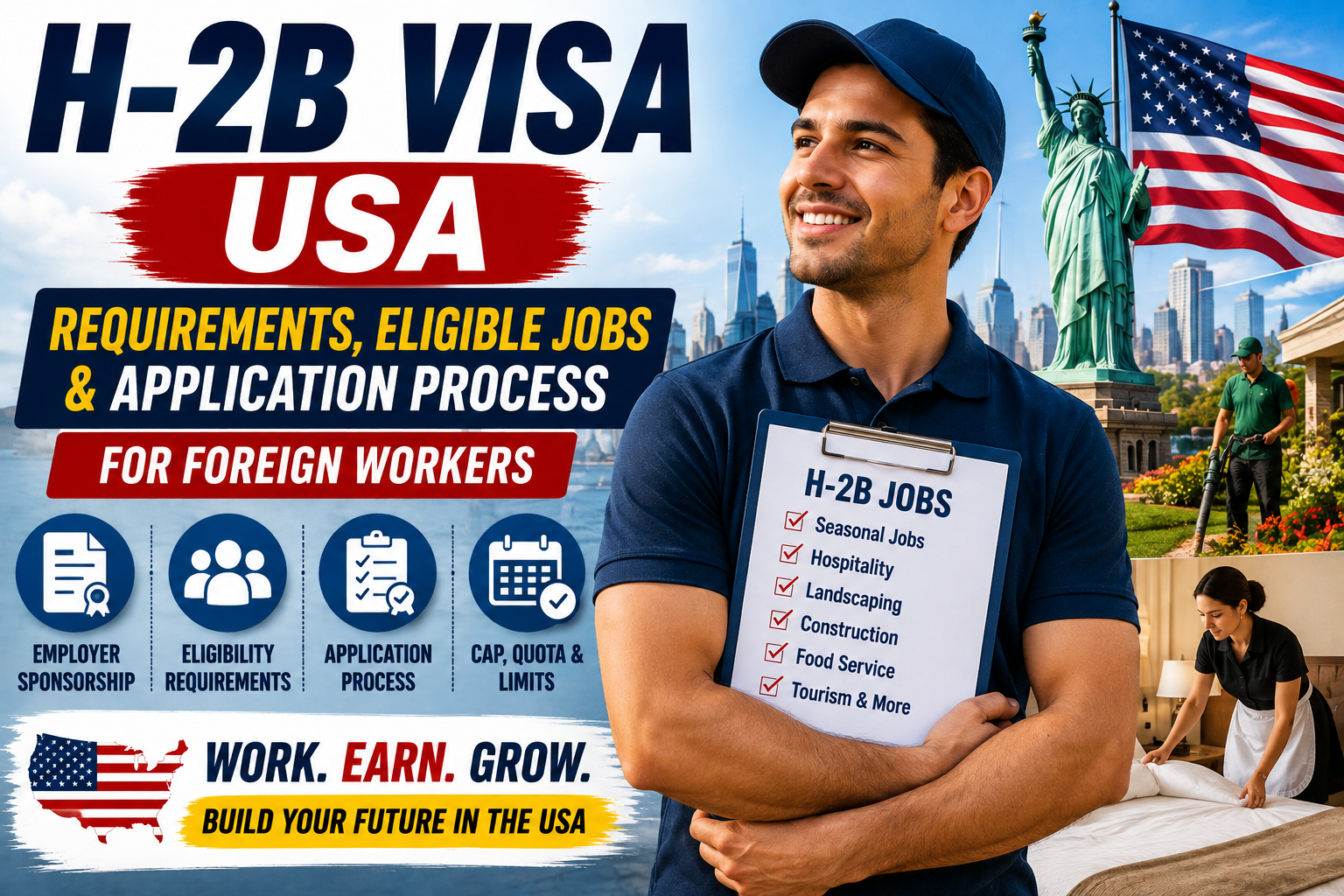
The United States employs foreign workers through several temporary and permanent immigration programs. For people interested in temporary, seasonal or short-term jobs outside agriculture, one of the most relevant categories is the H-2B visa.
The H-2B program allows qualifying U.S. employers to bring foreign workers to the United States for temporary non-agricultural work when the employer meets specific requirements.
This can include certain seasonal jobs in industries such as hospitality, landscaping, tourism, construction-related services and other businesses where the employer has a qualifying temporary need.
However, the H-2B program is not an open work permit.
A worker cannot simply apply for an H-2B visa without a qualifying U.S. employer and job. The employer must establish that its need is temporary and satisfy Department of Labor and USCIS requirements.
This guide explains how the H-2B visa works, who may qualify, what types of jobs can be involved, how sponsorship works, what the application process looks like and how international workers can protect themselves from recruitment scams.
Important: H-2B requirements, eligible-country rules, numerical caps, fees and procedures can change. Always verify current information through USCIS, the U.S. Department of Labor and the U.S. Department of State before applying.
What Is the H-2B Visa?
The H-2B visa is a temporary nonimmigrant classification for foreign workers performing temporary or seasonal non-agricultural work in the United States.
The U.S. Department of State lists H-2B under temporary worker visas for people performing temporary or seasonal non-agricultural work.
The program is employer-driven.
In other words, the U.S. business needs to demonstrate a qualifying temporary labor need and follow the required sponsorship process.
This makes H-2B very different from a general job-seeker visa.
What Kind of Jobs Can Be Available Through H-2B?
H-2B jobs can exist in many industries where the work is temporary and non-agricultural.
Potential examples include:
- Hotel and resort positions
- Hospitality jobs
- Landscaping
- Grounds maintenance
- Tourism-related work
- Certain amusement and recreational jobs
- Seafood processing
- Seasonal construction-related labor
- Food-service positions
- Ski resort jobs
- Other temporary service positions
The actual jobs available change according to employer demand.
A particular occupation being common in H-2B recruitment does not mean every employer in that industry automatically qualifies for the program.
The employer must demonstrate its own temporary need.
Four Main Types of Temporary Need
An employer generally needs to establish that its need for workers fits one of the recognized temporary-need categories.
These include:
- One-time occurrence
- Seasonal need
- Peakload need
- Intermittent need
USCIS materials describe these categories as the basic types of temporary need under the H-2B program.
Seasonal Need
A seasonal need occurs when a business regularly experiences a predictable period during which additional workers are needed.
A resort that needs extra staff during a recurring tourist season may be an example, depending on whether the employer meets all program requirements.
Peakload Need
A peakload need occurs when a business has a temporary increase in demand that requires additional workers beyond its normal permanent workforce.
Intermittent Need
An intermittent need may exist where the employer occasionally needs workers for short periods and does not maintain a regular full-time workforce for those services.
One-Time Occurrence
A one-time occurrence can involve a temporary situation where the employer needs additional workers for a specific event or circumstance.
The employer must provide evidence supporting its claimed temporary need.
Does H-2B Cover Agricultural Work?
No.
H-2B is for non-agricultural temporary employment.
Temporary agricultural employment generally falls under the separate H-2A program.
This distinction is important because many online job advertisements use the word “seasonal” without explaining which visa category applies.
Seasonal does not automatically mean H-2B.
The actual nature of the job determines which immigration program may be relevant.
Who Can Apply for H-2B?
The worker must satisfy the applicable requirements and be eligible for the H-2B classification.
The Department of State states that H-2B applicants generally must be nationals of countries designated as eligible for the program, subject to limited exceptions.
The list of eligible countries can change.
Therefore, an applicant should verify the current country-designation information instead of relying on a social media post or an old recruitment advertisement.
The Employer Is the Starting Point
A major feature of H-2B is that the process normally starts with the U.S. employer.
A foreign worker cannot simply decide to move to the United States and request H-2B status.
The employer needs to demonstrate the temporary need and complete the required procedures.
The general process involves the Department of Labor and USCIS.
The U.S. Department of State explains that most temporary worker visa applicants need an approved petition, which is generally filed by the prospective employer.
Department of Labor Temporary Labor Certification
Before filing the H-2B petition with USCIS in the normal process, the employer generally needs to obtain a temporary labor certification from the Department of Labor.
The purpose of this system includes protecting U.S. workers and ensuring that foreign workers do not adversely affect wages and working conditions.
The Department of Labor provides foreign-labor certification resources covering H-2B and other employment programs.
The employer must follow the applicable recruitment, wage and documentation requirements.
Prevailing Wage and H-2B
Wage requirements are an important part of the H-2B process.
The Department of Labor explains that foreign-worker programs generally involve prevailing wage requirements designed to protect the wages and working conditions of U.S. workers.
For H-2B, employers generally need a valid prevailing wage determination before filing the temporary labor certification application.
This means an H-2B employer should not simply choose an arbitrary low wage for foreign workers.
Applicants should carefully read the job offer, including:
- Hourly pay
- Expected working hours
- Overtime arrangements
- Housing information if provided
- Transportation details
- Work location
- Contract period
- Deductions
- Other employment conditions
H-2B Annual Cap
H-2B is subject to a statutory numerical cap.
The regular H-2B cap is 66,000 workers per fiscal year, historically divided into two halves of up to 33,000 workers associated with the first and second halves of the fiscal year.
Congress can authorize additional temporary H-2B numbers in certain circumstances.
Because supplemental allocations can change from year to year, applicants should not rely on a fixed statement such as “there are always X extra H-2B visas.”
The current fiscal-year rules should be checked directly.
Why the H-2B Cap Matters
The numerical cap means that demand for H-2B workers can exceed the number of available visas or statuses.
This can affect employers’ hiring plans.
A worker may have a genuine job offer and still face timing issues if the employer’s petition is subject to a numerical limitation.
This is another reason why an H-2B job should not be presented as a guaranteed route to the United States.
H-2B Application Process
The process usually involves several stages.
Step 1: Employer Identifies a Temporary Need
The employer determines that it needs temporary non-agricultural workers.
The employer must be able to demonstrate that the need fits an accepted temporary category.
Step 2: Prevailing Wage Determination
The employer obtains the applicable wage information through the Department of Labor process.
Step 3: Temporary Labor Certification
The employer completes the required labor-certification process, including recruitment and related requirements.
Step 4: Employer Files Form I-129
After completing the necessary Department of Labor steps, the employer generally files a Form I-129 petition with USCIS.
USCIS’s Form I-129 materials specifically contain an H-2A/H-2B section where employers identify the nature of the temporary employment, including seasonal, peakload, intermittent or one-time occurrence.
Step 5: USCIS Petition Decision
USCIS reviews the petition.
Approval is not automatic.
The employer must establish the required facts, and the worker must satisfy the applicable eligibility rules.
Step 6: Visa Application
If the worker is outside the United States, the worker generally applies for the H-2B visa through the appropriate U.S. embassy or consulate after the petition process.
The Department of State identifies the DS-160, passport, fee receipt and petition information among the typical documents for temporary worker visa applicants, although additional documentation may be requested.
Step 7: Travel to the United States
A worker may travel after receiving the appropriate visa and authorization to enter.
The visa itself does not guarantee admission.
The worker remains subject to inspection at the U.S. port of entry.
Documents H-2B Workers May Need
The exact documents depend on the case, but commonly relevant documents can include:
- Valid passport
- DS-160 confirmation
- Visa appointment information
- Petition receipt information
- Employment offer or contract
- Supporting employment documents
- Educational or experience evidence where relevant
- Photographs where required
- Other documents requested by the embassy or consulate
Workers should keep copies of important employment and immigration documents.
How Long Can an H-2B Worker Stay?
H-2B is temporary.
The length of authorized stay depends on the approved employment and applicable immigration rules.
The H-2B classification has a maximum period of stay framework, and periods in H-2 status can be subject to a three-year overall limitation before the worker may need to spend the required period outside the United States to qualify for a new period of H status.
Because extensions and periods of absence can have specific rules, workers should check their individual I-94 record and immigration documents rather than relying only on the visa expiration date.
Can H-2B Workers Bring Their Families?
Eligible spouses and unmarried children under 21 may generally qualify for H-4 dependent status.
The Department of State and USCIS materials recognize H-4 as the dependent classification associated with H workers.
However, family members’ rights are different from those of the H-2B principal worker.
An H-4 dependent should not assume that the dependent visa automatically provides employment authorization.
Families should check the current rules before making plans for a spouse to work.
Can an H-2B Worker Change Employers?
H-2B status is connected to the approved employment.
A worker should not assume that they can freely move to another company.
Changing employers generally requires the new employer to complete the appropriate immigration process.
Workers should obtain proper immigration guidance before leaving a sponsored job or starting a new one.
Is H-2B a Permanent Residence Visa?
No.
H-2B is a temporary nonimmigrant employment classification.
It does not automatically provide permanent residence.
An H-2B worker may eventually explore other immigration options if they independently qualify for them, but there is no automatic H-2B-to-green-card conversion.
For example, a worker could potentially be sponsored through an employment-based immigrant category in a separate process if the employer and worker meet all applicable requirements.
That is a different immigration case.
How to Find Legitimate H-2B Jobs
International workers should approach H-2B job searching carefully.
Start with:
Employer Websites
Look for the company’s official career page.
Verify that the business is real and that the advertised job actually exists.
Established Recruitment Platforms
Use established employment websites and professional recruitment channels.
Government Resources
The U.S. Department of Labor maintains information concerning foreign labor certification programs and related employer filings.
Direct Employer Contact
Where possible, communicate directly with the employer rather than relying entirely on an unknown intermediary.
Warning Signs of an H-2B Scam
H-2B workers can be vulnerable to recruitment scams because they may be searching for jobs from outside the United States.
Be extremely careful if a recruiter says:
“Pay us and your H-2B visa is guaranteed.”
That is a major warning sign.
Other red flags include:
- No real employer name
- No interview
- Fake-looking contract
- Unusually high salary for basic seasonal work
- Pressure to pay immediately
- Requests to send money through personal accounts
- Requests for unnecessary passport information
- Claims that a visa can be issued without an employer
- Guaranteed embassy approval
- Fake USCIS or Department of Labor letters
The Department of State provides legal-rights information specifically for H-2B workers and other temporary employment categories.
Workers should learn their rights before accepting an overseas job.
Should You Pay a Recruiter for an H-2B Job?
Be careful with recruitment fees.
H-2B recruitment involves specific legal requirements and worker protections.
A worker should not assume that every recruitment charge is legitimate simply because a recruiter claims it is required for “visa sponsorship.”
Ask for a written breakdown of any costs.
Verify information independently.
If a recruiter refuses to identify the U.S. employer or says you must keep the payment secret, consider that a serious warning sign.
H-2B Job Offer: What Should You Check?
Before accepting a job, review:
- Employer name
- Work location
- Job title
- Start date
- End date
- Hourly wage
- Expected hours
- Overtime information
- Accommodation arrangements
- Transportation arrangements
- Deductions
- Contract terms
- Visa classification
Make sure the job offer matches the actual petition and employment arrangement.
H-2B vs H-2A
The easiest way to understand the difference is:
H-2A = temporary agricultural work
H-2B = temporary non-agricultural work
Both programs involve employer sponsorship and temporary employment, but they have different rules.
If someone offers a farm job and calls it an H-2B job, ask questions and verify the visa classification.
H-2B vs H-1B
These visas are also very different.
H-1B generally targets specialty occupations requiring highly specialized knowledge and typically a bachelor’s degree or equivalent in the relevant specialty.
H-2B is for temporary non-agricultural work and can cover skilled or unskilled jobs where the employer has a qualifying temporary need.
This means an H-2B worker does not necessarily need a bachelor’s degree simply because they are working in the United States.
Common H-2B Mistakes
Mistake 1: Assuming Any Seasonal Job Qualifies
Seasonal work alone does not guarantee H-2B eligibility.
The employer must satisfy the temporary-need requirements.
Mistake 2: Paying for a Fake Job
Always verify the employer.
Mistake 3: Ignoring the Contract
Read the wage, dates, duties and work location carefully.
Mistake 4: Assuming H-2B Gives Permanent Residence
It does not.
Mistake 5: Assuming H-4 Family Members Can Automatically Work
Dependent employment rules are separate.
Mistake 6: Relying on Old Cap Information
H-2B numbers and supplemental allocations can change.
Final Thoughts
The H-2B visa can provide a legal temporary employment pathway for eligible foreign workers when a U.S. employer has a genuine temporary non-agricultural labor need.
It is especially relevant to international workers interested in seasonal or temporary employment.
However, the program is employer-driven and subject to specific requirements.
Workers should not treat an H-2B advertisement as proof that a visa is guaranteed.
Before accepting an opportunity, verify the employer, understand the contract, check the wage and working conditions and make sure the immigration process is being handled through legitimate channels.
The safest approach is to use official government information rather than relying on social media posts or unofficial agents.
Useful official resources include:
- USCIS – H-2B Temporary Nonagricultural Workers
- U.S. Department of State – Temporary Worker Visas
- U.S. Department of Labor – Foreign Labor Certification
- U.S. Department of Labor – Prevailing Wage Resources
Frequently Asked Questions
What is an H-2B visa?
H-2B is a temporary U.S. nonimmigrant classification for eligible foreign workers performing temporary non-agricultural work.
What jobs can use H-2B?
Potential jobs can exist in hospitality, tourism, landscaping, resorts, food services and other industries where an employer has a qualifying temporary need.
Do I need a U.S. employer?
Yes. The H-2B process is generally based on a petition filed by a qualifying U.S. employer.
Is H-2B permanent residence?
No. It is a temporary nonimmigrant employment classification.
How many H-2B workers are normally allowed each year?
The statutory regular cap is 66,000 per fiscal year, traditionally divided into two 33,000 portions. Congress can authorize supplemental allocations under certain circumstances.
Can H-2B workers bring their families?
Eligible spouses and unmarried children under 21 may generally qualify for H-4 dependent status.
Can H-2B workers change employers?
Changing employers involves immigration procedures. A worker should not simply start working for another company without confirming the required process.
Can I apply for H-2B without a job offer?
The program is employer-sponsored, so a genuine qualifying job and employer are central to the process.
Are H-2B jobs guaranteed?
No. A job advertisement does not guarantee a visa or admission to the United States.
How can I avoid H-2B scams?
Verify the employer, read the contract carefully, avoid guaranteed-visa promises and check information through official government sources.

Muhammad Usama is a digital content writer focused on immigration, visa, jobs, and international relocation topics.He creates clear, research-based guides to help readers better understand visa requirements, application processes, and opportunities abroad.